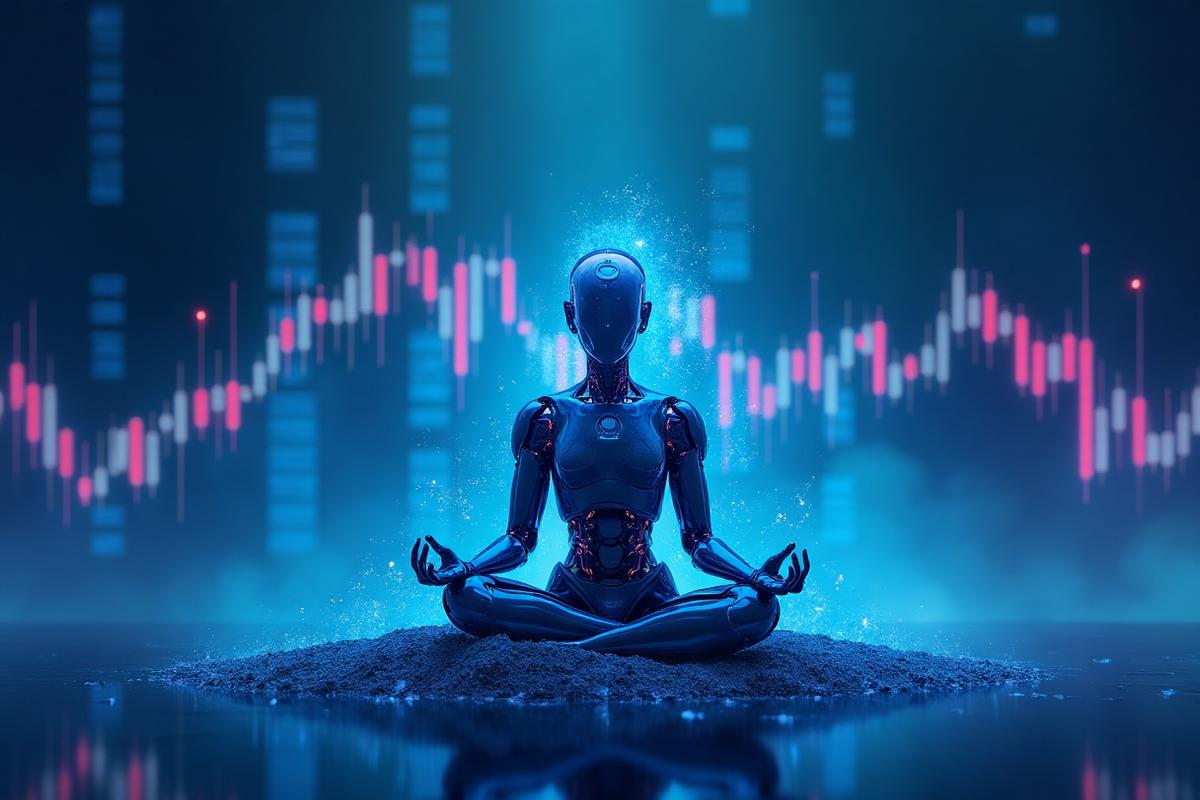
The human brain is a marvel of evolution, but it was designed for survival on the savanna, not for navigating the high-frequency volatility of modern financial markets. When a candle turns red on a 1-minute chart, your amygdala triggers the same "fight or flight" response it would for a physical predator, leading to catastrophic decision-making that erodes capital faster than any market crash.
🎯 Key Insight
Studies in neuroeconomics suggest that the pain of a financial loss is processed in the same area of the brain as physical pain. This biological hardwiring causes the average retail trader to underperform the market by over 6.5% annually due to emotionally charged "panic" exits and impulsive entries.
The Biological Glitch: Why Humans Are Bad at Trading
To understand why automation is the ultimate solution, we must first diagnose the problem: the human psyche. Traditional finance theory suggests that market participants are "rational actors," but behavioral economics tells a different story. We are governed by heuristics—mental shortcuts—that become liabilities in a trading environment.
The Cycle of Emotional Erosion
The typical emotional cycle of a trader starts with Optimism, which quickly turns to Euphoria as prices rise. It is at this peak—the point of maximum financial risk—that human psychology feels most confident, leading to "over-leveraging." When the inevitable correction occurs, euphoria turns to Denial, then Fear, and finally Panic.
- ▸Loss Aversion — The psychological tendency to feel the pain of losses twice as strongly as the joy of gains. This leads traders to "hold bags" of losing positions, hoping to break even, while cutting winning trades too early.
- ▸Recency Bias — The tendency to over-emphasize recent events. If the last three trades were losers, a trader may hesitate on a fourth signal, even if their strategy has a 70% historical win rate.
- ▸FOMO (Fear of Missing Out) — Driven by social proof and greed, this causes traders to enter positions at the top of a parabolic move, long after the risk-to-reward ratio has become unfavorable.
"In trading, the person who can sit still and do nothing is often the one who makes the most money. The problem is that the human brain is wired to 'do something' when it feels threatened." — Dr. Brett Steenbarger
The High Cost of "Revenge Trading"
One of the most destructive psychological phenomena in finance is revenge trading. After a significant loss, the ego feels bruised. The trader no longer views the market as a data set but as an adversary that "stole" their money.
In an attempt to "win it back," the trader will often double their position size or ignore their stop-loss protocols. This behavior ignores the mathematical reality of drawdowns. If a trader loses 50% of their account, they need a 100% gain just to return to break-even. By allowing emotion to dictate the recovery phase, most traders guarantee their eventual liquidation.
The Quantitative Solution
This is where algorithmic frameworks, such as the Nikeon AI trading platform, change the landscape. By removing the "Buy" and "Sell" buttons from human hands, the system treats a loss not as a personal failure, but as a statistical data point. When the ICS Capital Shield™ is active, the system can automatically throttle trading activity or tighten risk parameters during periods of high volatility, performing a "cool-down" that a human trader is psychologically incapable of doing.
How Automation Rewires the Trading Experience
Automated trading systems (ATS) don't just execute trades faster; they execute them without a pulse. This lack of biological feedback is the single greatest edge an investor can possess.
1. Rule-Based Consistency
An algorithm does not wake up "feeling bullish" or "feeling tired." It follows a coded set of instructions with 100% fidelity. If the criteria for a trade are met, it executes. If they are not, it stays in cash. This eliminates the "discretionary gap"—that moment of hesitation where a human trader talks themselves out of a winning setup because of a negative news headline they just read.
2. Backtesting and Confidence
Automation allows for rigorous backtesting across 10+ years of historical data. When a trader knows their system has survived the 2008 crash, the 2020 flash crash, and various bear markets, they are less likely to interfere with the bot during a temporary drawdown.
3. Multi-Market Scalability
A human can effectively monitor 2 or 3 tickers at once before cognitive load leads to errors. An automated system can monitor 500+ pairs across multiple exchanges simultaneously, applying the same disciplined logic to every single one.
🎯 Key Insight
Institutional desks now account for over 80% of trading volume on major exchanges. These firms do not rely on "gut feeling"; they utilize high-frequency algorithms that exploit the emotional mistakes made by retail traders who are still trading manually.
The Architecture of Discipline: ICS Capital Shield™
In the world of automated finance, risk management is not an afterthought—it is the core of the engine. While a human trader might "hope" a price bounces off a support level, an automated system uses hard-coded safeguards.
The ICS Capital Shield™ serves as a digital fiduciary. It operates on three distinct levels to ensure emotional discipline is enforced through code:
- ▸Dynamic Position Sizing — Automatically calculating the exact lot size based on current account equity to ensure no single trade risks more than 1-2% of the total portfolio.
- ▸Volatility Throttling — Identifying "black swan" events through rapid price deviations and moving the portfolio to stablecoins or neutral positions before a human could even open their laptop.
- ▸Correlation Checks — Ensuring the system doesn't accidentally over-expose the user to a single sector, a common mistake for manual traders who buy multiple assets that all move in tandem.
The Myth of the "Perfect" Entry
Manual traders spend 90% of their time looking for the "perfect" entry, driven by the greed-induced desire to catch the absolute bottom. Automation shifts the focus to what actually matters: the exit and the expectancy.
- ▸Fixed Targets — Algorithms take profits at pre-defined mathematical levels, ignoring the "just a little bit higher" greed that often leads to round-tripping a gain back into a loss.
- ▸Trailing Stop-Losses — Automation can adjust stops in real-time, locking in profits as a trade moves in the desired direction, a task that is mentally exhausting for a human to do manually for hours on end.
- ▸Time-Based Exits — If a trade hasn't moved within a certain timeframe, an algorithm can exit the position to free up capital, whereas a human will often stay "married" to the trade out of stubbornness.
What This Means for Traders
The transition from manual, emotional trading to an automated, systematic approach is not just a technical upgrade—it is a psychological liberation. By removing yourself from the decision-making loop, you move from being a "gambler" to being a "manager of a system."
Actionable Steps for Transitioning to Automation:
- ▸Audit Your Emotions — Keep a journal of your last 20 trades. Note how many were influenced by fear, boredom, or a desire to "get back" at the market. If that number is higher than 20%, you are a prime candidate for automation.
- ▸Deploy Incremental AI — You don't have to automate everything at once. Use platforms like Nikeon to handle specific strategies while you observe the consistency of the execution compared to your manual trades.
- ▸Trust the Math, Not the News — Recognize that the 24-hour news cycle is designed to trigger your emotions to drive clicks. An automated system ignores the narrative and focuses exclusively on price action and volume.
- ▸Embrace the "Boring" — Successful trading should be boring. If your heart is racing while you trade, you are doing it wrong. Automation turns the high-stress environment of the markets into a predictable, systematic process.
The future of wealth management is not found in "picking winners," but in the disciplined execution of a proven edge. As markets become faster and more complex, the only way to survive is to leave your heart at the door and let the code do the work.